How Blockchain Ensures Provably Fair Gaming
How Blockchain Ensures Provably Fair Gaming
Online gaming often leaves players questioning if outcomes are tampered with. Blockchain eliminates this doubt by using cryptographic methods to prove game results are fair, secure, and transparent. Here's how it works:
- Pre-committed Outcomes: Casinos generate a server seed, hash it, and share the hash before the game starts, locking in the outcome.
- Player Involvement: Players add their own randomness with a client seed, ensuring neither party can manipulate results.
- Verification: After the game, players can independently verify outcomes using tools like SHA-256 calculators.
- Decentralization: Smart contracts automate payouts and remove reliance on casino discretion.
- Transparency: All transactions and results are recorded on a public blockchain, making tampering impossible.
Platforms like Windice use these principles to offer games like Dice and Crash, combining low house edges (~1%) with instant crypto payouts. With provably fair gaming, you can verify every result yourself - no blind trust required.
Understanding Provably Fair Gaming And The Transparency Of Blockchain-Based Systems
How Blockchain Creates Provably Fair Systems
Blockchain technology shifts online gaming from relying on trust to delivering outcomes that players can verify independently. It achieves this through three key mechanisms: permanent records, cryptographic commitments, and decentralized verification. Together, these features ensure game results remain untampered and provable. Let’s break down how each mechanism works.
Permanent Public Records
Blockchain creates a permanent, unchangeable record of cryptographic commitments by timestamping and storing them. This provides an audit trail that ensures no one - neither players nor casinos - can alter the data. For instance, if a casino tried to modify a server seed after a bet was placed, the original hash stored on the blockchain would expose the manipulation.
"Blockchain acts as the ultimate notary. It timestamps and immutably stores these commitments (the hashes). This means a platform can't go back and change the initial seed after the fact." - Jeffrey, The Gambling Guy
This feature guarantees transparency by allowing players to cross-check outcomes with the original records, making it impossible to retroactively change results.
Transparency Using Cryptographic Hashes
Provably fair systems rely on SHA-256 hashing to secure game outcomes before they happen. Here’s how it works: the casino generates a server seed and immediately publishes its hashed version - a 64-character hexadecimal string. Think of it like sealing a prediction in an envelope. The hash locks in the outcome, but the actual seed remains hidden until after the bet is placed.
The avalanche effect ensures any tampering is obvious. Even a minor alteration to the server seed creates a completely different hash, making manipulation detectable.
This system ensures neither the casino nor the player can cheat. The seed is revealed only after the game, allowing players to verify the results. This process ensures outcomes are both predetermined and provably fair, giving players confidence in the system.
Decentralization Reduces Trust Requirements
Decentralization takes fairness a step further by eliminating the need to trust a single entity. Instead, it relies on verifiable mathematics.
Smart contracts handle everything automatically - from generating outcomes to calculating payouts and executing withdrawals. This means payouts happen instantly and are governed by code, not by a casino’s discretion.
"The core value proposition of provably fair systems is the replacement of blind trust with verifiable mathematics." - Chainlink
Players can independently verify results using tools like third-party SHA-256 calculators or local scripts. This ensures the verification process itself isn’t compromised. By removing the need for trust, decentralization empowers players to confirm fairness on their own.
How to Verify Game Outcomes on Blockchain
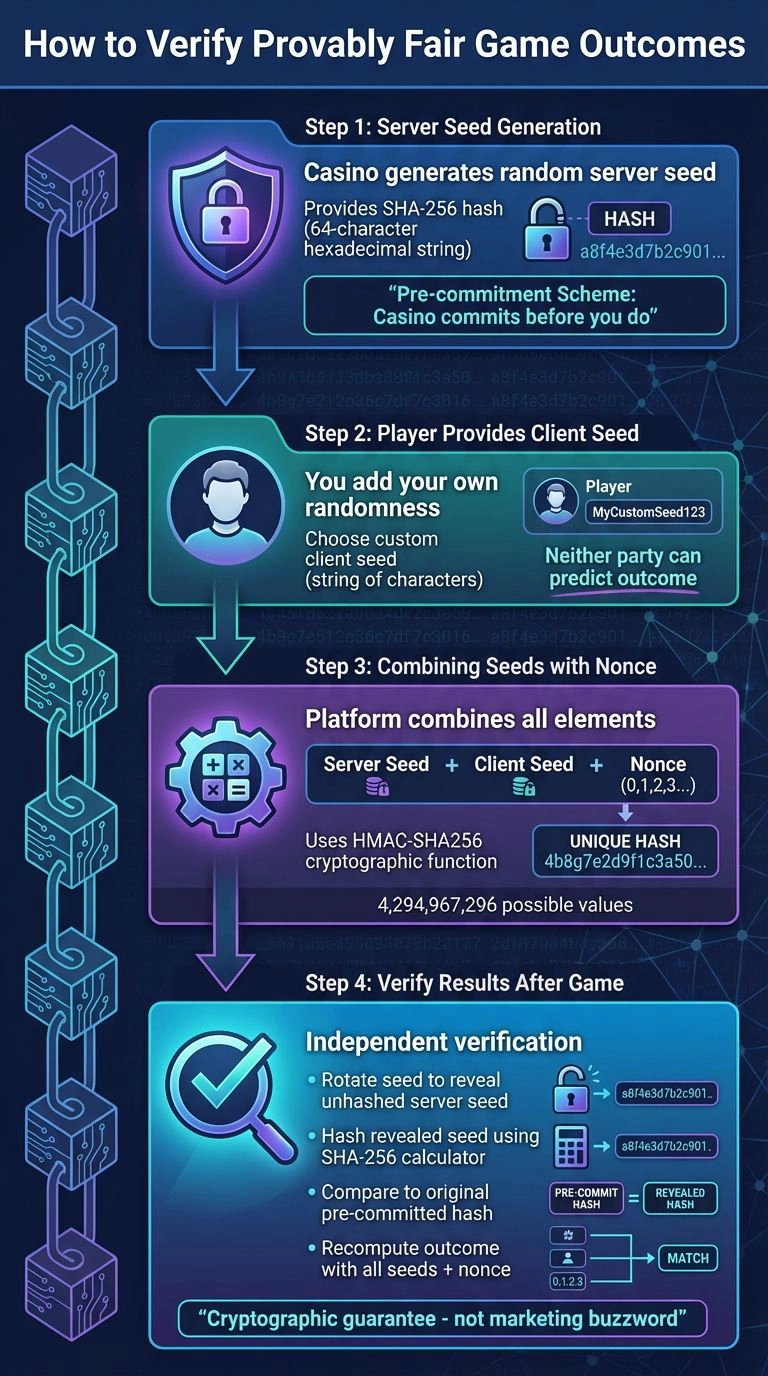
How to Verify Provably Fair Game Outcomes: 4-Step Blockchain Verification Process
Blockchain's transparent record-keeping makes verifying game outcomes straightforward. This process revolves around three key components: the server seed (a random string generated by the casino), the client seed (a string you choose), and the nonce (a counter that increases with each bet). Here’s how these elements work together to ensure every bet is secure and verifiable.
Step 1: Server Seed Generation
Before you place a bet, the casino generates a random server seed. Instead of showing you the seed directly, they provide its SHA-256 hash - a unique 64-character hexadecimal string that acts as a digital fingerprint. This hash ensures the seed is locked in and unchangeable. If the server seed were altered, its hash would change too.
"The strongest mechanism in Provably Fair gaming is the 'Pre-commitment Scheme.' The casino commits to their move before you commit to yours." - The Wager Theorem
Step 2: Player Provides Client Seed
Next, you add your own randomness by choosing a client seed - a string of characters you create. While platforms often provide a default seed, using your own adds an extra layer of security and ensures the casino cannot predict the outcome. This step balances control, so neither party can fully dictate the result.
Step 3: Combining Seeds with Nonce
The platform then combines the server seed, your client seed, and an incrementing nonce (0, 1, 2, 3…) using a cryptographic function like HMAC-SHA256. In this setup, the server seed acts as the cryptographic key, while the client seed and nonce form the message. The result is a distinct 64-character hash for each bet.
To determine the game outcome, the system converts the first eight characters of this hash from hexadecimal to a decimal integer, creating one of 4,294,967,296 possible values. Because the algorithm is deterministic, the same inputs (server seed, client seed, and nonce) will always produce the same result.
Step 4: Verifying Results After the Game
After the game, you can verify the fairness of your bets. Once you rotate your seed - usually through a "Rotate Seed" option in your account settings - the casino reveals the unhashed server seed. To confirm its validity, hash the revealed server seed using any independent SHA-256 calculator (like online tools) and check that it matches the pre-committed hash from Step 1.
Next, combine the server seed, your client seed, and the corresponding nonce to recompute the outcome. If the result matches what you observed during play, you can be confident the game was fair.
"Provably Fair is not a marketing buzzword. It is a cryptographic guarantee that the outcome of a bet was determined before the game started and was not altered in response to your wager." - Alex Novak, Security Researcher
For maximum assurance, always use open-source SHA-256 tools to independently verify outcomes.
Provably Fair Gaming on Windice

Windice embraces provably fair principles, giving players the tools to verify outcomes and enjoy transparent gaming, all supported by blockchain technology.
Games with Provably Fair Systems
Windice offers a selection of "Original" games built on blockchain-based provably fair mechanics. These include Dice, Crash, Plinko, and Roulette. Each game relies on a three-part cryptographic system: Server Seed, Client Seed, and Nonce. To ensure secure and fair outcomes, Windice uses SHA-256 and HMAC-SHA-512 algorithms for seed generation and hashing.
- Crash: Multipliers can climb as high as 9,900x.
- Dice: No minimum bet is required, and the house edge is around 1%.
Players can also customize their Client Seed, keeping game results unpredictable and transparent.
Built-In Verification Tools
Windice includes user-friendly tools for independent verification, accessible through the FAIR section. The "VERIFICATION" tool allows players to input their Server Seed, Client Seed, and Nonce to manually recalculate and confirm a specific bet's outcome. Each bet entry also includes a "Show Verification Info" button, which displays the necessary details for auditing.
To review previous bets, you can use the "GENERATE NEW" option to reveal the unhashed Server Seed from your last session. For optimal fairness and randomness, it’s advisable to rotate your seeds every 10,000 to 100,000 bets.
Transparent Gaming with Instant Crypto Payouts
Windice pairs its fair gameplay with near-instant cryptocurrency withdrawals. Transaction IDs (TXIDs) are typically generated almost immediately, bypassing the lengthy waiting periods often associated with traditional payment systems. Supported cryptocurrencies include BTC, ETH, USDT, DOGE, and LTC. Additionally, the platform provides an internal exchange, allowing users to swap between these currencies directly within their wallets.
All transactions are recorded on the blockchain, reinforcing transparency. As a "KYC-light" platform, Windice offers a streamlined registration process, but enabling Google 2FA is strongly recommended to secure your account and funds. Combining verifiable fairness with quick payouts, Windice creates a gaming experience where players have control over both the randomness of outcomes and the speed of their withdrawals.
Why Provably Fair Gaming Benefits Players
Provably fair gaming gives players the ability to verify fairness through mathematical proof, turning online gambling into a "see for yourself" experience. Here's how these assurances translate into real advantages for players.
Verified Fair Outcomes Build Trust
Provably fair gaming eliminates the need for blind trust by using a pre-commitment system that locks in outcomes before bets are placed. Because players provide their own client seed - which the casino cannot predict - results can't be manipulated in the casino's favor. Sophie Langford, Lead Payments & Usability Auditor at Gambling Bitcoin, highlights the significance of this system:
"With this technology, cheating becomes mathematically impossible to hide"
This cryptographic setup ensures every game result is predetermined and verifiable, removing reliance on the operator's promises.
Players Can Verify Results Independently
Players can check any bet themselves using open-source tools like SHA-256 calculators or Python scripts. Since the system is deterministic - meaning the same inputs always yield the same outputs - auditing past results becomes simple. If the server seed revealed after the game doesn't match the pre-game hash, tampering is undeniable. This independence eliminates the need for costly third-party audits or reliance on internal casino tools.
Complete Transparency in Gaming
Provably fair systems ensure full transparency, removing any possibility of manipulation. Unlike traditional RNG casinos, which hide results behind proprietary algorithms, provably fair platforms show exactly how outcomes are generated using openly shared inputs. This transparency reassures players that losses stem from the mathematical house edge - about 1% in provably fair games, compared to 3% to 5% in standard casinos - rather than any interference from the operator.
| Feature | Traditional RNG Casinos | Provably Fair Gaming |
|---|---|---|
| Trust Model | Blind faith in the operator | Mathematical verification |
| Verification | Periodic third-party audits | Real-time, player-driven audits |
| Player Role | Passive recipient | Active participant via client seeds |
| House Edge | 3% to 5% | Around 1% |
| Return to Player | 95% to 97% | 98% to 99% |
Conclusion
Blockchain is reshaping online gaming by replacing blind trust with cryptographic proof. Through cryptographic hashing, public ledgers, and player-generated randomness, game outcomes are now predetermined and fully verifiable. This approach not only ensures secure outcomes but also shifts the balance of power toward the player.
This shift - from "trust us" to "see for yourself" - represents a major change in how players engage with online casinos. The process, which involves seed generation and independent verification, forms the backbone of every provably fair game. Built-in verification tools make this transparency tangible, enabling players to conduct instant audits themselves. Add to this the benefits of instant crypto payouts, a house edge of around 1%, and blockchain-recorded transaction IDs, and you have a system where fairness is not just claimed but proven.
Provably fair gaming offers Return to Player (RTP) rates of 98%–99%, compared to the 95%–97% typical of traditional casinos. Sophie Langford, Lead Payments & Usability Auditor at Gambling Bitcoin, captures the essence of this shift:
"Provably fair gambling is not just a feature. It is the new standard. It shifts the power dynamic from the casino to the player".
These cryptographic guarantees put control directly into the hands of players. They can verify every game outcome independently and in real time, eliminating the need for third-party audits or internal assurances. Here, the math truly speaks for itself.
FAQs
What does “provably fair” actually prove?
“Provably fair” refers to a system that guarantees game outcomes are genuinely random, secure from tampering, and can be independently checked by players. This is made possible through cryptographic techniques, ensuring transparency and fostering trust in online gambling platforms.
What’s the difference between a server seed, client seed, and nonce?
A server seed is a hidden number created by the casino, which is revealed after the game to confirm that the outcome was fair. The client seed, on the other hand, is a random string chosen by the player, allowing them to have some influence on the result. Meanwhile, the nonce is a unique number that increases with every bet, ensuring each result is distinct and can be tracked.
Does blockchain fairness also guarantee I’ll get paid out?
Blockchain technology allows game outcomes to be mathematically verified, offering a level of transparency and trust that’s hard to beat. But here’s the catch: this doesn’t automatically mean your payout is guaranteed. The casino still has to process and complete the transaction properly. That’s why it’s crucial to choose a platform with a strong reputation for secure and prompt payouts. Always do your homework before placing your bets.