Avoiding Common Timing Mistakes in Crash Games

Avoiding Common Timing Mistakes in Crash Games
Crash games are all about timing. Your goal is to cash out before the multiplier crashes, but mistakes like cashing out too early, holding out too long, or chasing losses can quickly drain your bankroll. Here's how you can avoid these pitfalls:
- Cashing Out Too Early: Fear of losing often leads to small, safe wins. However, this limits long-term gains. Gradually increase your target multiplier (e.g., from 1.5× to 2.0×) and use auto-cashout tools to stick to your plan.
- Waiting Too Long: Chasing high multipliers like 10× can result in frequent losses. Set realistic auto-cashout limits (e.g., 2×–3×) to balance risk and reward.
- Chasing Losses: Increasing bets to recover losses only worsens your situation. Stick to the 1–2% rule for bets and set stop-loss limits to protect your bankroll.
- Ignoring Patterns: While outcomes are random, observing trends like crash clusters or stable windows after high multipliers can help manage risk. Use demo modes to practice spotting these patterns.
- Relying on Manual Timing: Human reaction delays can lead to missed opportunities. Automate your bets and cashouts to remove emotional decision-making and ensure consistency.
Crash Games Ultimate Cash Out Strategy: 89% Success Rate
Cashing Out Too Early
One of the biggest pitfalls in crash games is cashing out at low multipliers - like 1.2× or 1.5× - due to the fear of an immediate crash, especially when past losses weigh heavily on your mind.
Watching live-feed cashouts can add to this pressure, tempting you to abandon your plan and follow the crowd. Then there’s the "near-miss effect", where narrowly avoiding a loss fuels frustration and encourages overly cautious behavior. This often leads to locking in small gains repeatedly instead of aiming for bigger rewards.
Here’s the thing: in a game with a 97% RTP (Return to Player), you lose an average of $0.03 for every $1 you bet, no matter if you cash out at 1.5× or 10×. For example, while a 1.5× strategy gives you a win rate of around 64.67%, cashing out at 1.2× means a single loss can erase the profits of as many as five wins. So, while early cashouts might keep your bankroll steady in the short term, they also limit your chances of earning more substantial gains over time.
Recognizing this timing mistake is the first step toward adopting a smarter, data-driven strategy.
Solution: Adjust Your Targets Gradually
To break the habit of early cashouts, start by gradually increasing your target multipliers. Observe crash patterns over 20–30 rounds. If the multipliers often land between 2.0× and 3.0×, consider raising your auto-cashout from 1.5× to 2.0×. This small adjustment can help you capture larger rewards without significantly increasing your risk.
Stick to the 1–2% rule: only bet 1–2% of your bankroll per round. For instance, if you’re working with $100, limit your bets to $1–$2 per round.
Take advantage of auto-cashout features to avoid impulsive decisions in the heat of the moment. For example, you could set your target at 1.8× and let the system handle the rest. Platforms like Windice offer tools to help you stick to your strategy without being swayed by emotions. As your confidence and bankroll grow, you can gradually increase your target to 2.0×, then 2.5×, balancing risk with the potential for bigger rewards.
Waiting Too Long for High Multipliers
On the flip side of cashing out too early, there’s the temptation to hold out for sky-high multipliers like 5× or 10×. This often happens when you're riding a winning streak and feeling overly confident. While it might seem like patience, this approach is often rooted in greed and a false sense of control over the game’s outcome. Just as cashing out too soon caps your gains, holding out too long exposes you to unnecessary risks.
Here’s the reality: the crash point is determined by a random number generator. The rising animation you see? It’s purely cosmetic and doesn’t predict anything. Statistically, a 2× multiplier gives you a 48.5% chance of winning, but that plummets to just 9.7% at 10×. The numbers don’t lie - discipline in cashing out is crucial.
Take this example: with a $100 bankroll and $1 bets, the chance of losing everything is less than 0.1% if you aim for a 1.5× multiplier. But if you’re chasing 10×, that risk skyrockets to about 35%. At that level, you could face losing streaks of 50–70 rounds in a 1,000-round session, compared to just 12–15 rounds if you stick to a 2× multiplier. That’s a punishing grind, one that most bankrolls can’t handle.
Solution: Use Auto-Cashout Limits
To avoid the trap of chasing unrealistic multipliers, consider setting auto-cashout limits at more achievable levels - typically between 2× and 3×, depending on your risk tolerance. Platforms like Windice offer an auto-cashout feature that helps you stick to your plan and removes the emotional element. For example, you could set your target at 2.5× before the round starts and let the system take care of the rest. This eliminates second-guessing and impulsive decisions.
If the platform allows, you might also experiment with a dual-bet strategy. For instance, set one bet to auto-cashout at 1.5× to lock in a base win, and another to aim for 5× for a shot at extra profit. This approach blends safety with the potential for occasional big wins, treating those higher multipliers as bonuses rather than the main focus of your strategy. It’s a way to keep your game plan balanced while still leaving room for some excitement.
Chasing Losses with Risky Timing
When players experience consecutive losses, many fall into a pattern known as loss-chasing. This involves increasing bet sizes and delaying cashouts in a desperate attempt to recover their losses. Kelly Tow and Dr. Anastasia Hronis describe it perfectly:
"The more you lose, the more desperate you feel to gain the money back, and the more bets you find yourself placing to try and break even... It's like trying to reach a goalpost that just keeps moving further and further away."
However, chasing losses doesn’t alter the math of the game. For example, in a 97% RTP (Return to Player) game, you’re still expected to lose $0.03 for every $1 wagered, no matter how much you bet. Even strategies like the Martingale system - doubling your bet after every loss - don’t improve your odds. After 10 consecutive losses while targeting a 2× payout, you’d need to risk $1,023 just to recover a $1 profit. As GamblingCalc puts it:
"The strategy doesn't change the math - it simply reshapes the variance into many small wins and rare catastrophic losses."
Psychological factors make this behavior even riskier. The gambler’s fallacy tricks you into believing a win is "due" after a losing streak, prompting you to raise your stakes when your bankroll is already fragile. Then there are near-miss outcomes - when the multiplier crashes just shy of your target. These moments create an illusion of control, pushing you to take even bigger risks in the next round. This cycle of distorted judgment and poor timing is so prevalent that 60% of individuals meeting at least one diagnostic criterion for gambling disorders report engaging in loss-chasing.
Solution: Set Bankroll Limits
To avoid the dangers of loss-chasing, adopting a disciplined approach to bankroll management is crucial. One effective method is setting a strict stop-loss limit - stop playing after losing 10% of your daily budget. For example, if your bankroll for the day is $100, stop after losing $10. Many platforms, such as Windice, offer auto-stop features that log you out once your limit is reached, ensuring you stick to your plan.
Another helpful strategy is the 1-2% rule: limit each bet to just 1–2% of your total bankroll. With a $100 budget, this means betting $1 to $2 per round. This approach helps you weather losing streaks without depleting your funds. Additionally, use auto-cashout tools to stick to fixed multiplier targets, such as 1.5× or 2×. Letting the system handle the timing removes the emotional urge to "wait just a little longer" in hopes of recovering losses. The aim here isn’t to chase what you’ve lost - it’s to safeguard what you still have.
Ignoring Patterns and Not Adjusting Strategy
Many players dive into crash games relying on gut feelings rather than analyzing game data. This often leads to the Gambler's Fallacy - the false belief that past outcomes influence future results. In reality, every round is independent, and no amount of "intuition" can change that.
Emotions can also take over, leading to "Tilt." This happens when frustration clouds judgment, causing players to abandon their strategy and make reckless bets. In the heat of the moment, key patterns in the game's behavior may go unnoticed. For example, around 3% of rounds crash instantly at 1.00x, and there's a 51.71% chance of a crash before hitting 2.00x.
Experienced players, however, pay attention to these patterns. They recognize trends like "crash clusters", where 3–4 rounds in a row end between 1.00x and 1.50x, or "safe windows", which often follow rare high multipliers (50x+). During these windows, the next 10–15 rounds tend to stabilize within a 1.5x–5x range. As one expert put it:
"Smart players don't predict crashes - they manage timing." - Aviator 13
Even with a 97% RTP (Return to Player), meaning you lose $0.03 for every $1 wagered on average, the secret isn't in predicting outcomes but in timing your bets wisely. Recognizing patterns and understanding the game's rhythm can make all the difference.
Solution: Watch Rounds Before Betting
To improve your timing, start by observing several rounds without placing any bets. Watch 5–10 rounds to get a feel for the game's volatility and flow. If you notice a streak of 3–4 low multipliers, consider waiting a few more rounds before entering with a low-risk auto-cashout set around 1.40x.
Using demo modes is another effective way to practice. These allow you to familiarize yourself with the game’s rhythm without risking real money. Reviewing the last 50–100 rounds can also help you spot crash clusters or periods of stability, further refining your strategy. Platforms like Windice enhance this approach by offering a Provably Fair system. Their use of SHA256 cryptographic hashing ensures round outcomes are genuinely random and verifiable.
After a very high multiplier (50x+), it can be smart to sit out for 10–15 rounds or aim for more conservative targets. This is because the game often enters a "cooldown" phase during which multipliers stabilize at lower levels. The goal here isn't to predict the future - it's about using real-time data to manage your exposure effectively.
Relying Only on Manual Timing
Manual cash-outs might seem manageable, but hesitation can quickly turn a winning bet into a losing one. The problem lies in that moment of indecision - when you think, "just a little more", only to watch the multiplier crash and your stake vanish. As BC.GAME explains:
"The biggest mistake is greed - waiting too long to cash out and losing everything when the game crashes."
Human reaction time, combined with internet latency, creates a risky delay. Crash games are fast - most rounds wrap up in under 30 seconds. By the time your brain processes the decision, your finger clicks the button, and your internet connection sends the command, the multiplier may have already collapsed.
Distractions only make things worse, increasing the chances of "last-tick busts" where the multiplier crashes just before you act. The pressure of a rapidly rising multiplier often leads to mistakes, like abandoning your strategy to chase unrealistic payouts. This lack of consistency can derail even the most carefully planned approach. In crash games, timing is everything, and relying solely on manual actions leaves too much room for error.
To avoid these pitfalls and stick to a disciplined strategy, automation is the key.
Solution: Use Auto-Bet and Auto-Cashout
Automating your bets removes the hesitation and delays that come with manual timing. By setting an auto-cashout target before the round starts, you eliminate emotional decision-making and secure your winnings the moment your target multiplier is reached. As professional poker player Mike Waters puts it:
"I recommend using the auto cashout option because it prevents emotional decision-making and ensures disciplined play."
Auto-bet features also help maintain consistency across rounds. For instance, you can stick to a strategy like cashing out at 1.5× every round, avoiding impulsive decisions that could jeopardize your bankroll. If you're new to crash games, starting with an auto-cashout target between 1.3× and 1.6× is a smart way to secure small, steady wins while learning the game mechanics.
Platforms like Windice offer tools to automate your bets and even provide free-play modes to practice strategies without financial risk. Use demo mode to get a feel for the game's pace and test automated settings. Once you're ready, you can set stop-loss and stop-win limits to automatically pause your session when you hit a specific profit or loss threshold. These features help you stay disciplined and avoid emotional over-betting.
Building a Timing Strategy Framework
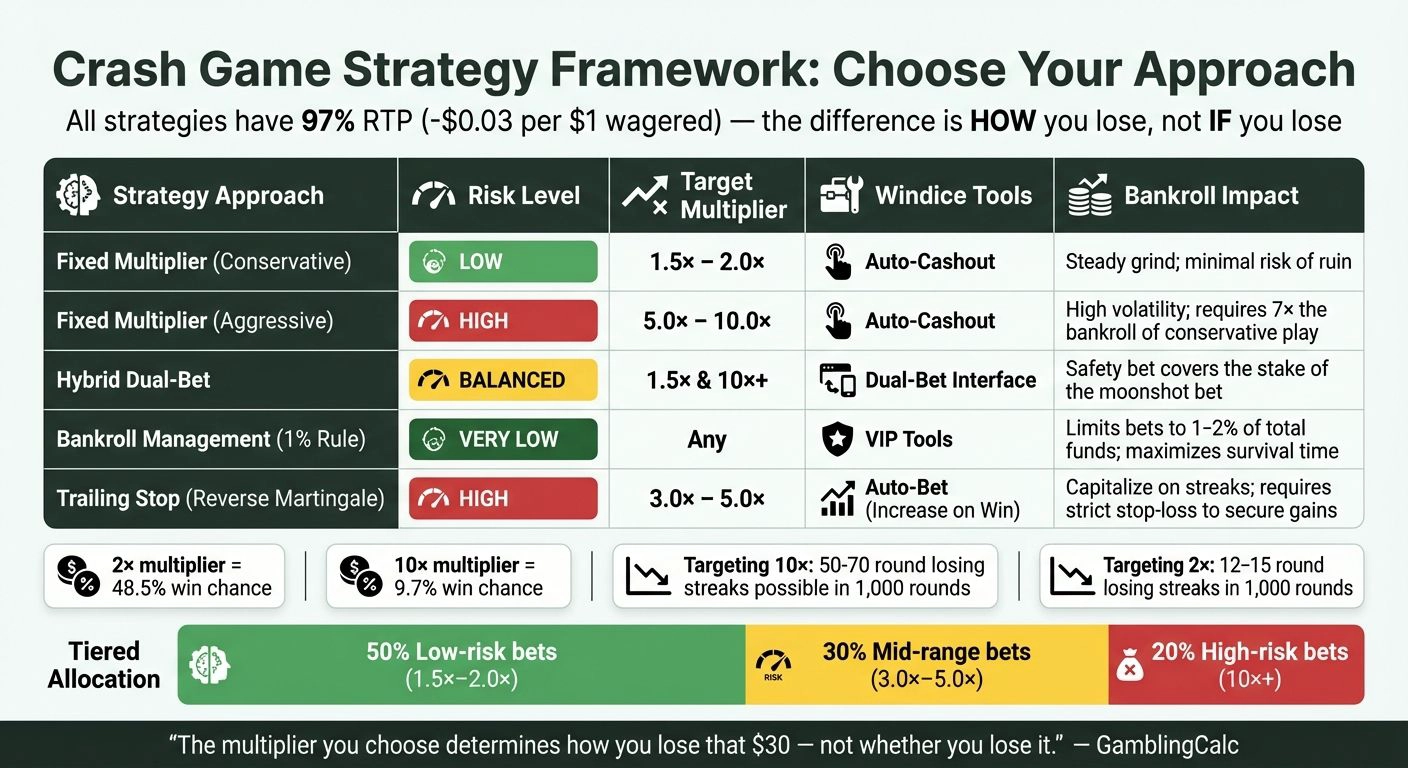
Crash Game Strategy Comparison: Risk Levels, Multipliers, and Bankroll Impact
Creating a structured framework for your timing strategy can help reduce common timing mistakes. To do this effectively, it's important to align your approach with your personal risk tolerance. Here’s a key fact to keep in mind: every multiplier target in crash games has the same expected value. For example, in a 97% RTP game, you'll lose $0.03 for every $1 wagered, regardless of whether you cash out at 1.5× or 10×. The difference lies in how you lose, not if you lose. As GamblingCalc explains:
"The multiplier you choose determines how you lose that $30 - not whether you lose it."
Matching Your Strategy to Risk Tolerance
Your betting framework should reflect your comfort level with risk. For instance, low multipliers like 1.5× provide frequent wins and lower chances of depleting your bankroll, especially when using $1 bets on a $100 bankroll. However, aiming for higher multipliers, such as 10×, increases the risk of losing 35% of your bankroll. The trade-off isn’t about profitability - it’s about variance. Conservative players may see steady, small wins, while aggressive players endure longer losing streaks in pursuit of big payouts. By aligning your bet sizes with expected variance, you can better manage your approach.
The 1–2% Rule for Bankroll Management
Stick to the 1–2% rule: limit your bets to 1–2% of your total bankroll. This guideline helps you endure inevitable losing streaks without depleting your funds. For example, if you’re targeting a 10× multiplier, you might encounter losing streaks lasting 50–70 rounds in a 1,000-round session. Keeping your bets small ensures you’ll have enough funds to wait out these streaks.
Tiered Allocation for Balanced Play
A tiered allocation strategy offers a blend of safety and potential rewards. Divide your session bankroll as follows: 50% for low-risk bets (1.5×–2.0×), 30% for mid-range bets (3.0×–5.0×), and 20% for high-risk bets (10×+). You can also use tools like Windice's dual-bet feature to place a "safety" bet at a low multiplier, which covers your total stake, while a smaller bet chases higher multipliers. Combining automated tools with this allocation method strengthens your overall strategy.
Strategy Comparison Table
Here’s a breakdown of different approaches within this framework:
| Strategy Approach | Risk Level | Target Multiplier | Windice Tools | Bankroll Impact |
|---|---|---|---|---|
| Fixed Multiplier (Conservative) | Low | 1.5× – 2.0× | Auto-Cashout | Steady grind; minimal risk of ruin. |
| Fixed Multiplier (Aggressive) | High | 5.0× – 10.0× | Auto-Cashout | High volatility; requires 7× the bankroll of conservative play. |
| Hybrid Dual-Bet | Balanced | 1.5× & 10×+ | Dual-Bet Interface | Safety bet covers the stake of the moonshot bet. |
| Bankroll Management (1% Rule) | Very Low | Any | VIP Tools | Limits bets to 1–2% of total funds; maximizes survival time. |
| Trailing Stop (Reverse Martingale) | High | 3.0× – 5.0× | Auto-Bet (Increase on Win) | Capitalize on streaks; requires strict stop-loss to secure gains. |
This table highlights how different strategies can suit varying risk levels and goals, giving you flexibility to choose the approach that fits your play style and bankroll. By using these tools and frameworks, you can refine your timing strategy while managing risk effectively.
Conclusion
Avoid timing errors by removing emotions from the equation, setting achievable goals, and leveraging automation. As Robottler insightfully notes:
"Every losing pattern in crash games is emotional. Every winning pattern is mechanical".
Relying solely on manual timing pits you against greed, hesitation, and the urge to hold out for "just one more tick." Automation, like auto-cashout, removes these emotional pitfalls by ensuring your exit happens the moment your target multiplier is hit.
The math doesn't lie: in a game with a 97% RTP, you lose $0.03 for every $1 wagered, no matter your target multiplier. The key difference isn't about if you lose - it's about how you lose. Conservative targets lead to steadier outcomes, while aggressive ones significantly reduce success rates and raise the likelihood of losing your bankroll. This underscores the importance of a disciplined, automated strategy.
Windice offers tools designed to support this disciplined approach. Features like auto-cashout, dual-bet systems, and stop-loss settings help you stick to your plan. For example, the dual-bet interface allows you to place a "safety" bet at 1.5× to cover your stake while using a smaller bet to aim for higher multipliers. The provably fair system ensures every crash point is predetermined and verifiable, giving you confidence in the game's fairness. Additionally, the progressive faucet provides a way to recover without succumbing to the pressure of depositing more funds.
Stick to the 1–2% rule for bet sizing, use auto-cashout to enforce your targets, and take regular breaks every 15–20 minutes to maintain focus. As Stephen R. Tabone wisely puts it:
"Luck decides the outcome - discipline decides the damage".
FAQs
What’s a good auto-cashout multiplier for beginners?
For those just starting out, setting an auto-cashout multiplier between 1.50x and 2.00x is a smart move. This range strikes a good balance by minimizing risk while still leaving room for decent potential gains. Plus, it helps lower the chances of losing due to early crashes.
How do I set a stop-loss and stop-win for crash sessions?
To manage your gameplay effectively, set clear stop-loss and stop-win limits before you start. For instance, you might decide your maximum loss will be 10-20% of your bankroll, while your profit target could be 20-30%. Keep an eye on your results, and once you reach either limit, end your session. This approach helps you stay in control and manage risks during crash gaming.
Do patterns in crash games actually help, or is it all random?
Crash games might appear to follow patterns, but the truth is, they don’t. The outcomes are completely random, with each round being independent of the last. What may seem like a trend or pattern is purely coincidental and doesn’t influence future results in any way.