Crypto Casino Withdrawal Times Explained
Crypto Casino Withdrawal Times Explained
When withdrawing from crypto casinos, speed and simplicity are top advantages. Crypto withdrawals bypass traditional banking systems, moving funds directly to your wallet. Here's what you need to know:
- Faster Transactions: Unlike fiat withdrawals that take 3–7 business days, crypto transactions can complete in minutes. Solana and Litecoin often process in under 5 minutes, while Bitcoin takes 10–60 minutes after approval.
- Lower Fees: Crypto eliminates intermediaries, reducing fees. However, Ethereum can become costly during peak times, with gas fees reaching $15–$20.
- Privacy: Many platforms require minimal personal details unless withdrawing large sums.
- 24/7 Availability: Crypto networks operate continuously, enabling withdrawals anytime.
How It Works:
- Request the Withdrawal: Select your crypto, input the amount, and provide your wallet address.
- Casino Review: Casinos verify your request for fraud, AML compliance, and bonus terms.
- Blockchain Processing: Transactions are confirmed on the blockchain, with speed varying by network.
- Funds Received: Once confirmed, funds appear in your wallet.
Factors Affecting Speed:
- Casino Processing: Internal reviews can cause delays, especially for large withdrawals or incomplete KYC.
- Blockchain Congestion: High network traffic can slow confirmations.
- Crypto Choice: Coins like Solana, Litecoin, and XRP are faster than Bitcoin or Ethereum.
For the fastest withdrawals, complete KYC early, avoid peak times, and choose fast cryptocurrencies like Solana or USDT on TRC-20. Reliable platforms like Windice offer average payout times of 5 minutes, ensuring a smooth withdrawal experience.
Crypto Gambling: How to Cash Out Without Getting Flagged
How Crypto Casino Withdrawals Work
The withdrawal process generally involves four steps: requesting the withdrawal, casino processing and verification, blockchain confirmation, and finally, receiving the funds. Let’s break down each stage to understand how it all works.
Step 1: Requesting a Withdrawal
To start, head to the Cashier, Withdraw, or Wallet section of your casino account. Choose your cryptocurrency, enter the amount you want to withdraw, and carefully copy and paste your wallet address to avoid errors. Double-check the first and last four characters of the address on both the casino and your wallet screens to ensure accuracy.
Another critical step is selecting the correct blockchain network. For example, if withdrawing USDT, confirm whether you’re using the TRC-20 or ERC-20 network - choosing the wrong one could lead to permanent loss of funds. Once everything is set, submit your request. The casino will then begin its internal review process.
Step 2: Casino Processing and Verification
After submission, your withdrawal request enters the casino’s internal review phase. This is where delays often occur. The casino typically runs automated checks for risk, AML (anti-money laundering) compliance, and ensures you’ve met any bonus wagering requirements. If you haven’t completed the KYC (Know Your Customer) process, this step can take anywhere from a few minutes to 48 hours.
Large withdrawals or unusual activity - like sudden IP changes or winnings far above your usual amounts - can trigger a manual review. This may extend the pending period to 24–48 hours.
"Internal casino approval is where delays almost always happen. This is why two casinos using the same crypto network can have wildly different payout times." – CoinBettors
Once the casino approves your request, it moves to the blockchain for further processing.
Step 3: Blockchain Confirmation
After passing the casino’s checks, your transaction is sent to the blockchain. Miners then verify it and add it to new blocks. Each block adds a confirmation to the transaction. For example, Bitcoin generates a new block roughly every 10 minutes, and most casinos consider a transaction finalized after 1 to 3 confirmations.
You can monitor your transaction in real time using blockchain explorers like mempool.space for Bitcoin or Etherscan for Ethereum. Just enter the Transaction ID provided by the casino to see its progress.
Step 4: Receiving Your Funds
Once confirmations are complete, your funds will appear in your wallet. While they might show up immediately, they’ll often remain unspendable until the required confirmations are finalized - this typically takes 10–60 minutes for Bitcoin and 5–20 minutes for Ethereum. If you’re using faster networks like XRP, confirmations can happen in under 5 minutes.
For added security and speed, transfer the funds to a private, non-custodial wallet like Ledger or Trust Wallet. This helps you avoid potential delays or restrictions associated with custodial wallets.
Factors That Affect Withdrawal Processing Times
Understanding what slows down your crypto withdrawal can help you plan ahead and avoid unnecessary frustration. While blockchain technology is known for its speed, several factors can add minutes - or even hours - to the process.
Casino-Side Processing Times
One of the biggest delays happens during the casino's internal approval process. Most platforms run automated checks to detect fraud, money laundering, or account misuse before releasing funds. If your Know Your Customer (KYC) verification is incomplete, this step could take anywhere from a few minutes to up to 48 hours, particularly for first-time withdrawals or large amounts.
Another common cause of delays is bonus compliance checks. If you’ve used a bonus, the casino may need to confirm that all terms have been met before processing your withdrawal. Opting to play without a bonus can often speed things up. Additionally, activities like logging in from a new device or using a VPN can trigger security measures, temporarily freezing your withdrawal request.
"Blockchain speed is rarely the issue. Internal casino approval is where delays almost always happen." – CoinBettors
Once the casino clears your withdrawal, external factors come into play.
Blockchain Network Congestion
After approval, the transaction moves to the blockchain. Here, network congestion can significantly impact processing times. During busy periods, such as when transaction volumes spike or NFT minting events occur, delays are common. Miners and validators prioritize transactions with higher fees, so if your withdrawal has low gas fees, it may sit in the queue - or "mempool" - for longer.
For example, Bitcoin transactions typically take 10–60 minutes, but during heavy congestion, they can stretch to hours or even days. Ethereum withdrawals usually process within 5–30 minutes, but gas price surges can cause delays. To stay informed, you can use tools like mempool.space (for Bitcoin) or Etherscan (for Ethereum) to monitor network traffic.
"During high demand - such as increased transaction volume, NFT minting, or gambling spikes - withdrawals may be significantly delayed." – Marco Lucchetti, Senior Content Strategist and Blockchain Analyst, Plisio
The cryptocurrency you choose also plays a crucial role in determining withdrawal speed.
Cryptocurrency Type
The speed of your withdrawal often depends on the specific cryptocurrency you’re using. Each coin operates on a unique network with varying "block times", or the time it takes to add a new block to the blockchain. For instance, Bitcoin generates a new block roughly every 10 minutes, whereas faster networks like Solana or TRON (TRC-20) can process transactions in as little as 2 minutes.
Additionally, most casinos require 3 to 6 blockchain confirmations before finalizing a withdrawal. This means the total processing time can vary significantly based on the cryptocurrency.
If speed is your priority, consider using coins like Litecoin (LTC), Solana, or USDT on TRC-20. Litecoin transactions typically take less than 10 minutes, while XRP can process in just 3 minutes. Choosing a faster cryptocurrency can make a noticeable difference in how quickly you receive your funds.
Average Withdrawal Times by Cryptocurrency
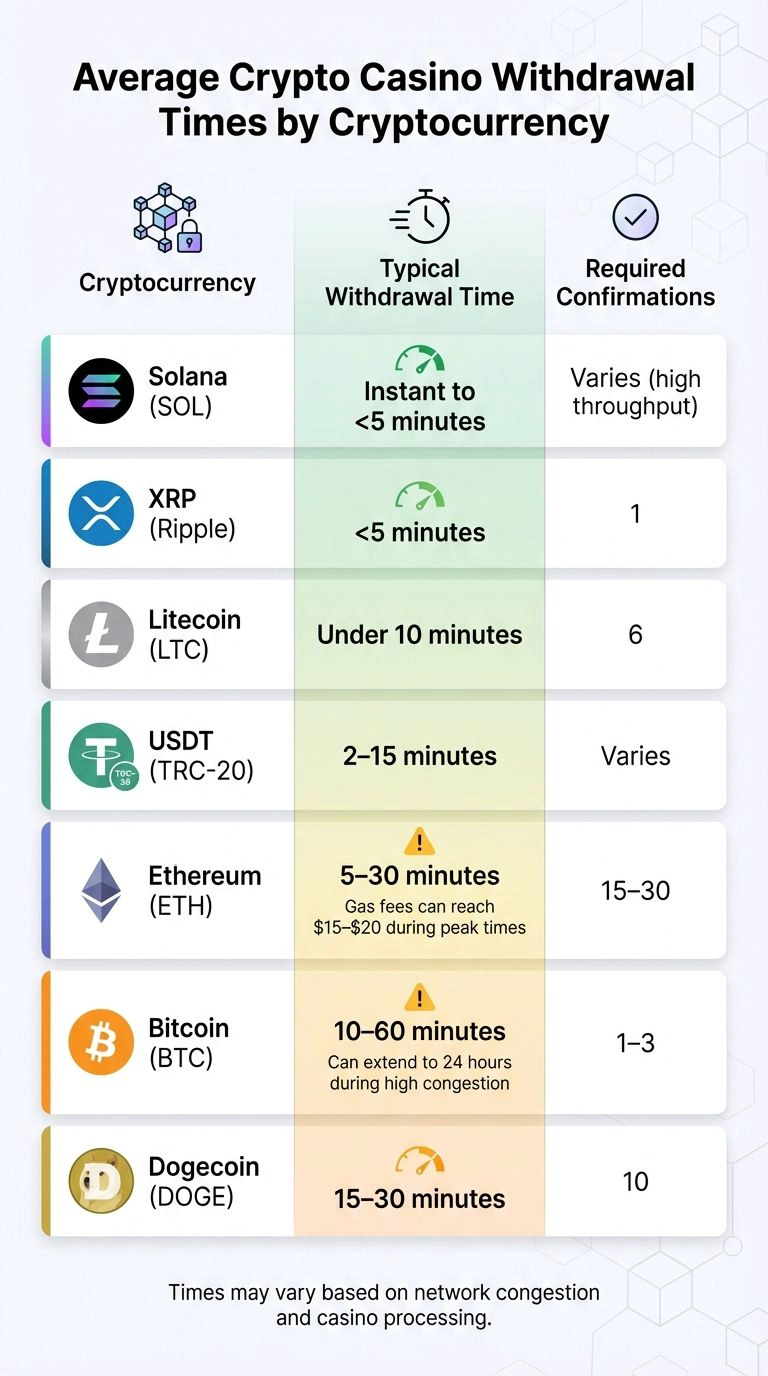
Crypto Casino Withdrawal Times Comparison Chart by Cryptocurrency
Withdrawal speeds can vary greatly depending on the cryptocurrency you use. Factors like network congestion, confirmation requirements, and transaction fees all play a role in determining how quickly your funds will be available. Here's a breakdown of average withdrawal times for some of the most popular cryptocurrencies, along with their typical confirmation needs.
Bitcoin: 10–60 Minutes
Bitcoin withdrawals generally take anywhere from 10 to 60 minutes, depending on the number of confirmations required (usually 1–3). However, during periods of high network activity, delays can stretch up to 24 hours.
Ethereum: 5–30 Minutes

Ethereum withdrawals are typically completed within 5–30 minutes, with a median transaction time of about 57 seconds under normal conditions. That said, sudden spikes in network activity can cause delays and push transaction fees to $15–$20.
Other Cryptocurrencies: Solana, Litecoin, and More

If you're looking for faster withdrawal options, consider these alternatives:
- Solana (SOL): Known for its high transaction throughput, Solana withdrawals often clear in under 5 minutes.
- Litecoin (LTC): With a block time advantage, Litecoin transactions usually process in less than 10 minutes, requiring 6 confirmations.
- Ripple (XRP): XRP is one of the quickest options, often finalizing in under 5 minutes with just 1 confirmation needed.
- USDT on the TRC-20 Network: Stablecoin users can benefit from TRC-20's efficiency, where withdrawals typically take 2–15 minutes and come with minimal fees.
Comparative Table of Withdrawal Times
| Cryptocurrency | Typical Withdrawal Time | Required Confirmations |
|---|---|---|
| Solana (SOL) | Instant to <5 minutes | Varies (high throughput) |
| XRP (Ripple) | <5 minutes | 1 |
| Litecoin (LTC) | Under 10 minutes | 6 |
| USDT (TRC-20) | 2–15 minutes | Varies |
| Ethereum (ETH) | 5–30 minutes | 15–30 |
| Bitcoin (BTC) | 10–60 minutes | 1–3 |
| Dogecoin (DOGE) | 15–30 minutes | 10 |
Tips for Faster Crypto Casino Withdrawals
Getting your winnings quickly often comes down to preparation and making smart choices. If you're tired of waiting around for your funds, here are some practical steps to speed up the process.
Use Verified Wallet Addresses
Double-check your wallet address every time you submit a withdrawal request. Even one wrong character can result in your funds being lost forever. A safer option is to use a QR code scanner rather than typing the address manually. This simple step minimizes human error.
Also, ensure that the network you're using matches the cryptocurrency you're withdrawing. For example, sending USDT through the wrong network (like ERC-20 instead of TRC-20) can lead to irreversible losses. If you're working with stablecoins like USDT, confirm that your wallet supports the specific network - whether it's TRC-20, ERC-20, or BEP-20 - before proceeding.
For an even smoother process, take care of identity verification early on.
Complete KYC Before Requesting Withdrawals
Even if you're using a "no-KYC" casino, large withdrawals often trigger identity verification requirements. To avoid delays of 12–72 hours, submit your government-issued ID and proof of address as soon as you register. Completing your KYC early and enabling 2FA (two-factor authentication) ensures that future withdrawals are processed faster, often automatically, without requiring manual review.
The cryptocurrency you choose also plays a big role in how quickly you'll see your funds.
Choose Faster Cryptocurrencies
Some cryptocurrencies process transactions much faster than others. For instance, Solana (SOL) and Litecoin (LTC) often complete withdrawals in under five minutes. On the other hand, Bitcoin transactions can take anywhere from 10 to 60 minutes, and Ethereum's gas fees can jump to $15–$20 during high-demand periods.
For the fastest and most cost-effective withdrawals, TRC-20 USDT and Solana are excellent choices.
"For speed and value, TRC20 and Solana are the clear winners right now." - Nick Hall, Senior Editor
Lastly, consider where you're withdrawing your funds. Private, non-custodial wallets like Trust Wallet or MetaMask are much faster than exchange wallets. Exchanges often introduce additional processing delays, even after the blockchain confirms the transaction. If you need to transfer funds to an exchange later, you can do that separately at your convenience.
Windice Instant Payouts: Average 5 Minutes

For over seven years, Windice has been delivering withdrawals at an impressive average speed of just five minutes. This efficiency is no accident - it's the result of carefully refined systems and processes that prioritize swift transactions.
Overview of Windice Withdrawal Features
Windice exclusively handles withdrawals in cryptocurrency, supporting nine major coins: BTC, ETH, USDT, BNB, TRX, LTC, XRP, DOGE, and BCH. Even better, the platform charges 0% withdrawal fees and imposes no limits on the amount users can withdraw for any of these cryptocurrencies.
Withdrawals are processed instantly, bypassing any third-party delays. Thanks to blockchain verification, transactions are completed in just a few minutes.
Windice's 7-Year Track Record for Fast Payouts
Since 2018, Windice has maintained a solid reputation for reliable payouts. With minimal payout issues and round-the-clock customer support, Windice has proven itself as a trustworthy platform.
This kind of reliability doesn’t happen overnight. Fast payouts are the result of automated systems, thorough risk assessments, and wallet batching - all of which have been fine-tuned over years of operation. Unlike newer platforms that may promise instant payouts, Windice's long-standing record demonstrates that experience and well-honed processes make all the difference.
Conclusion
Crypto withdrawals operate 24/7, offering blockchain transparency and delivering funds in minutes rather than days. However, the actual speed depends on a mix of internal processing and blockchain confirmations.
Internal processes - such as bonus eligibility checks, fraud prevention measures, and KYC (Know Your Customer) compliance - can sometimes add a few hours to the payout timeline. Once cleared, withdrawal times vary by cryptocurrency: Bitcoin typically takes 10–60 minutes, Ethereum 5–20 minutes, and faster networks like Solana can settle transactions in under 5 minutes.
To streamline withdrawals, consider completing KYC verification early, opting for faster cryptocurrencies, and avoiding peak network traffic. Double-checking withdrawal details beforehand can also help sidestep unnecessary delays. These proactive steps highlight the value of choosing a trustworthy platform.
"Speed means nothing without trust. A casino that's been around for years, consistently paying out and keeping players happy, is worth far more than a flashy new name promising instant everything." - Nick Hall, Senior Editor at Casinos.org
Platforms like Windice, with a 7-year track record and an average payout time of 5 minutes, prove that reliable systems and established processes are essential for smooth crypto withdrawals. Ultimately, a combination of efficient internal workflows and rapid blockchain confirmations ensures a seamless cash-out experience.
FAQs
Why is my crypto withdrawal still pending?
Your crypto withdrawal could be delayed for several reasons, such as network congestion, low transaction fees, or the casino's internal processing times. Heavy blockchain traffic can slow things down, while insufficient fees might result in your transaction being deprioritized by miners. Additionally, the casino may take extra time to verify your request before initiating the transfer.
How can I track my withdrawal on the blockchain?
To keep tabs on your withdrawal, use the transaction ID (TXID) or payout ID given by the casino after you initiate the withdrawal. Simply input the TXID into the blockchain explorer for the cryptocurrency you’re using (like Bitcoin or Ethereum). This will provide details such as the number of confirmations and let you verify whether your funds are being processed or have already arrived in your wallet.
What happens if I pick the wrong network (like USDT TRC-20 vs ERC-20)?
Choosing the wrong network - like using USDT TRC-20 instead of ERC-20 - can result in delays, failed transactions, or even losing your funds. This occurs because mismatched networks can lead to incompatibility or rejection of the transaction. To avoid such issues, always double-check the network you're using before moving forward to ensure everything goes smoothly.