Crypto Volatility: Planning Bankroll for Price Swings

Crypto Volatility: Planning Bankroll for Price Swings
In crypto gambling, your funds face two risks: the outcome of bets and the unpredictable swings of the crypto market. A sudden 30% drop in Bitcoin’s value can shrink your bankroll even if you haven’t placed a single bet. This dual risk makes managing your bankroll far more challenging compared to using stable currencies like the U.S. dollar.
Here’s what you need to know:
- Crypto volatility affects bankroll value: A 15% market drop could turn $30,000 into $25,500 overnight.
- Emotional stress is amplified: Market swings can lead to impulsive decisions, like chasing losses or holding out for bigger gains.
- Bet sizing requires constant adjustments: To maintain consistent risk, you’ll need to recalculate bets based on crypto’s fluctuating value.
- Stablecoins offer stability: Using assets like USDT or USDC can protect your bankroll from market swings.
To protect your funds, stick to percentage-based betting (1–3% of your bankroll per bet), set win/loss limits (e.g., stop after a 10% gain or 5% loss), and withdraw winnings regularly. Diversify your game choices and allocate funds wisely: keep 10–20% in a hot wallet for active play, 50–70% in secure storage, and 20–30% in stablecoins as a buffer.
Crypto gambling requires discipline and preparation. Without a clear strategy, you’re gambling on both the games and the market.
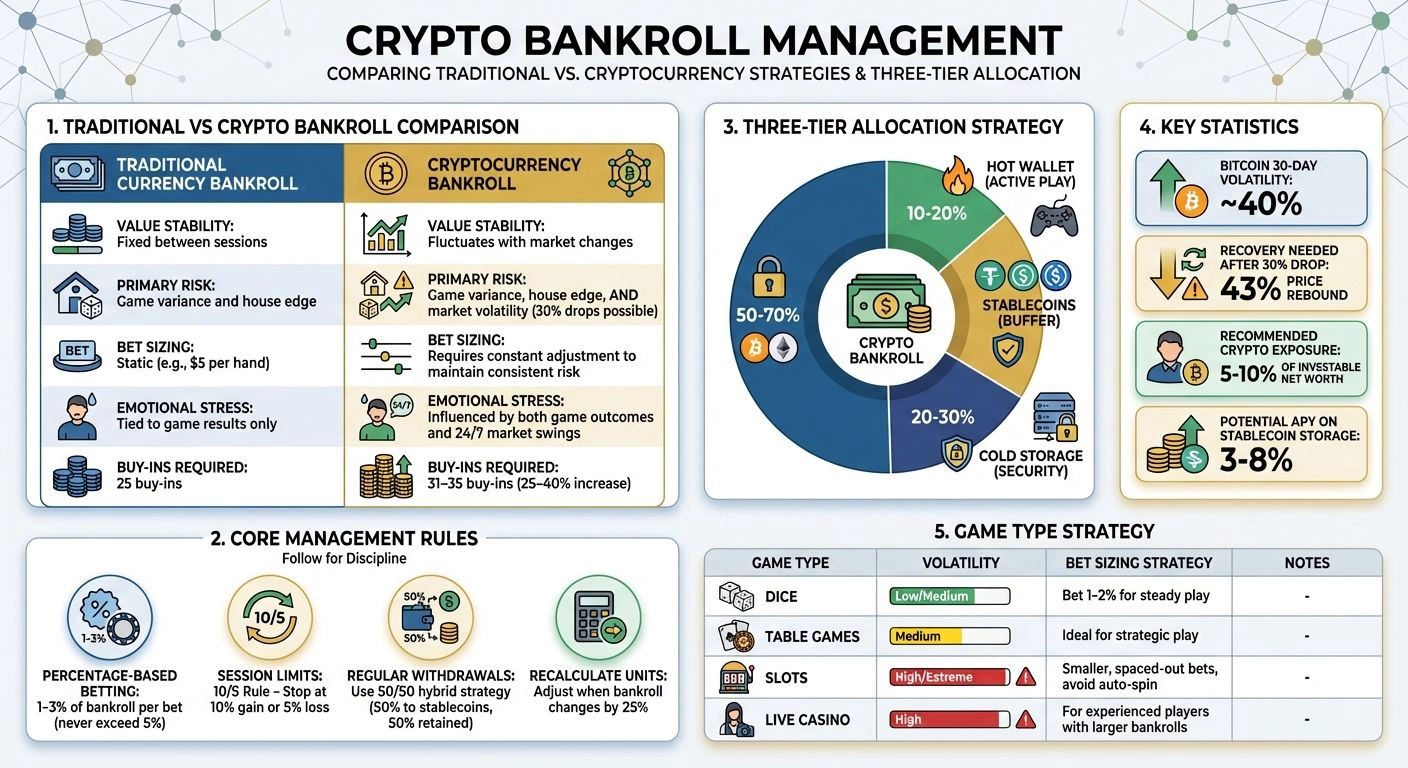
Crypto vs Traditional Bankroll Management: Key Differences
How Cryptocurrency Volatility Affects Your Bankroll
Price Changes and Bankroll Value
A traditional casino bankroll in dollars offers a predictable value - $500 today will still be $500 tomorrow. But with cryptocurrency, that stability disappears. Adrian Barkley from Crypto Daily puts it well:
"You're playing two games at once. 1. The casino game itself
2. The market value of the coin you're using."
This dual layer of risk introduces what experts call buying power fluctuations. For example, if you deposit 0.5 BTC when Bitcoin is valued at $60,000, your bankroll starts at $30,000. But if Bitcoin drops 15% to $51,000, your bankroll shrinks to $25,500 - without you placing a single bet. That’s a $4,500 loss in real-world value.
On the flip side, market rallies can turn a break-even session into a win. Imagine you gain 0.1 BTC during your session, and the price of Bitcoin jumps 20%. Suddenly, your winnings are worth significantly more. This volatility means market movements can obscure your actual casino performance.
Another challenge is bet sizing. With a traditional bankroll, you can keep bets static - say, $10 per hand. But with crypto, you need to adjust constantly. Betting 0.01 Bitcoin when its value doubles means you’re risking twice as much in real terms. To counter this, many professional players use a strategy called parallel sizing. They set their base bet in dollars (e.g., $2) and convert it to the crypto equivalent before each session.
| Feature | Traditional Currency Bankroll | Cryptocurrency Bankroll |
|---|---|---|
| Value Stability | Fixed between sessions | Fluctuates with market changes |
| Primary Risk | Game variance and house edge | Game variance, house edge, and market volatility |
| Bet Sizing | Static (e.g., $5 per hand) | Requires adjustment to maintain consistent risk |
| Emotional Stress | Tied to game results | Influenced by both game outcomes and market swings |
These constant adjustments don’t just impact your bankroll - they also affect how you approach decisions, as explored below.
Emotional Responses to Market Volatility
Market swings don’t just hit your wallet - they mess with your emotions. A sudden 10% drop in Bitcoin’s value can trigger panic, leading to impulsive decisions like cashing out or chasing losses. On the other hand, during a price surge, FOMO (Fear Of Missing Out) can kick in. Players may hold onto their crypto winnings, hoping for even bigger gains, only to suffer if the market reverses.
Unlike traditional currencies, cryptocurrencies are traded 24/7, which means constant price updates. This creates a level of stress that doesn’t exist with stable currencies. With dollars, your focus stays on the game. With crypto, you’re juggling the outcomes of your bets and the unpredictable market.
As Investopedia wisely states:
"The goal isn't to predict every wave, but to ride them with understanding and discipline."
To manage these emotional pressures, seasoned crypto gamblers often establish strict systems. These might include setting stop-loss limits, capping session lengths, or deciding in advance when to convert winnings to stablecoins or fiat currency. These strategies help maintain focus and prevent emotional swings from derailing their gameplay.
Creating a Separate Cryptocurrency Bankroll
If you're going to gamble with cryptocurrency, one of the first steps is keeping your gambling funds separate from your other money. This helps you manage risks and avoid unnecessary financial stress.
Separating Gambling Funds from Personal Money
Never mix gambling funds with money meant for essentials like rent, food, or savings. Keeping a dedicated bankroll ensures your day-to-day finances are protected.
This separation makes it easier to track your gambling performance. When gambling funds are mixed with your general crypto portfolio, it becomes harder to tell whether your gains are due to your gambling strategy or just market trends.
Determining Your Starting Bankroll Amount
Your gambling bankroll should come strictly from disposable income - money left over after covering necessary expenses like bills, groceries, and taxes. A common rule of thumb is to allocate 2% to 5% of your monthly disposable income to gambling. For example, if you have $2,000 in disposable income each month, your gambling budget would fall between $40 and $100.
You’ll also need to decide how to structure your bankroll. Here are two common approaches:
- Fixed Crypto: Set aside a specific amount of a cryptocurrency, knowing its value may fluctuate with the market.
- Fixed Fiat: Convert a set dollar amount into crypto each time you play, ensuring consistent risk exposure regardless of market changes.
If you’re looking to avoid the impact of crypto volatility, stablecoins like USDT or USDC are great options. For instance, starting with 500 USDC gives you a stable, unchanging value, making it easier to track your gambling performance without worrying about price swings.
Once you’ve established a clear and secure bankroll, you’ll be ready to apply effective management strategies.
Bankroll Management Techniques That Work
When it comes to the unpredictable nature of crypto, having a structured approach to bankroll management is a game-changer. These strategies can help you navigate not only the ups and downs of gambling but also the wild price swings in the crypto market.
Percentage-Based Betting
The golden rule of crypto gambling is straightforward: limit your bets to between 1% and 3% of your total bankroll for each wager. If you're dealing with high volatility, it’s wise to stick to just 1% or 2% per bet. No matter how confident you feel, never bet more than 5% of your bankroll on a single play.
Crypto’s dual risk - game variance and market swings - requires disciplined bet sizing. For comparison, while traditional fiat gambling might call for 25 buy-ins for a game, crypto gamblers often need 31 to 35 buy-ins (a 25% to 40% increase) to handle the added volatility. By setting your bets as a percentage of your bankroll, you can better weather sudden market fluctuations.
One method is to use a unit system, where 1 unit equals 1% of your bankroll. Recalculate your unit size whenever your bankroll changes by about 25%.
Setting Session Win and Loss Limits
Predetermined win and loss limits are your safety net, protecting you from impulsive decisions and unexpected market crashes. A useful guideline is the 10/5 Rule: stop playing after a 10% gain or a 5% loss in a session.
These limits are especially critical in crypto gambling, where you’re battling on two fronts. For instance, a 30% drop in the crypto market can shrink your bankroll by the same amount, even if your gambling results break even. To recover from such a drop, you’d need a 43% price rebound just to get back to your starting point.
When you hit your win limit, consider converting some of your profits into stablecoins like USDT or USDC. This step locks in your gains and shields them from potential market downturns. Many experienced crypto gamblers keep 20% to 30% of their bankroll in stablecoins as a buffer against volatility.
Once these limits are set, you can further reduce risk by diversifying the types of games you play.
Balancing Game Types
Different casino games affect your bankroll in different ways. High-volatility slots may offer big payouts, but they can also lead to long losing streaks. On the other hand, lower-volatility games like dice or certain table games provide more consistent results.
A smart move is to diversify your bets across games with varying volatility levels. This approach can help stabilize your returns during market turbulence. For example, use low-volatility games for warm-ups and confidence-building, while reserving only a small portion of your bankroll for high-risk, high-reward games.
| Game Type | Volatility Level | Recommended Strategy |
|---|---|---|
| Dice | Low to Medium | Bet 1-2% for steady play and to ease into a session |
| Table Games | Medium | Ideal for strategic play with moderate risk |
| Slots | High to Extreme | Place smaller, spaced-out bets; avoid auto-spin |
| Live Casino | High | Best for seasoned players with larger bankrolls |
A simple tip: avoid auto-spin features on high-volatility games. Slowing down your gameplay can stretch your bankroll and help you manage crypto price swings more effectively.
When and How to Withdraw Winnings
Regularly withdrawing your winnings is a smart way to protect your bankroll from the unpredictable swings of the crypto market. Sudden price drops can wipe out gains, and recovering from those losses often takes significant time and effort.
One effective approach is the 50/50 hybrid strategy: convert half of your winnings into stablecoins like USDT or USDC to lock in profits, while leaving the other half in your original cryptocurrency to take advantage of potential market gains. Adrian Barkley sums it up perfectly:
Withdraw 50% to secure profits and retain 50% for potential gains. This balanced approach manages risk and capitalizes on market cycles.
To make your withdrawals more systematic, set clear triggers. For example, withdraw when your bankroll grows by about 25%, when your hot wallet holds more than 2–3 weeks' worth of play, or if your asset allocation drifts 5%–7% from your target. During periods of high volatility, it’s wise to shorten your sessions and cash out more frequently.
Keep a close eye on your bankroll in both cryptocurrency and U.S. dollars. Converting some of your winnings into stablecoins can help you get a clearer picture of your betting performance. Once you withdraw, securing those funds becomes the next priority.
A good rule of thumb is the 80/20 rule: keep only 20% of your total gambling bankroll on the betting platform and move the remaining 80% into secure storage. Options like hardware wallets or yield-bearing stablecoin accounts are excellent choices. This practice follows the "Not your keys, not your coins" principle, safeguarding your funds from platform risks while potentially earning 3% to 8% APY on your idle bankroll.
Using Bonuses and Promotions Wisely
Using bonuses effectively can be a smart way to stretch your bankroll, especially in the unpredictable world of crypto markets. However, this strategy only works if you fully understand the terms and conditions tied to these offers. For instance, a 300% match bonus might sound appealing, but if it comes with a 40× wagering requirement, you’ll need to wager 40 times the bonus amount before you can withdraw any winnings. In volatile markets, such conditions can quickly make the bonus more trouble than it’s worth.
Reading Bonus Terms and Conditions
Before jumping on a bonus offer, it’s essential to examine three key elements: wagering requirements, game contribution percentages, and maximum bet limits.
- A 40× wagering requirement is considered high by today’s standards. If this multiplier applies to both your deposit and the bonus, the requirement essentially doubles.
- Not all games contribute equally toward clearing a bonus. Slots often contribute 100%, but table games or live dealer games might only count for 5% to 25%. This disparity matters - a $500 bonus with a game contributing just 10% could require $200,000 in wagers to clear, compared to $20,000 with a 100% contribution.
- Most bonuses also impose a cap, typically around $5 per spin or hand, while the bonus is active. Exceeding this limit can void your winnings.
Additionally, bonuses often come with expiration dates, ranging from 24 hours to 30 days. Failing to meet the requirements within this timeframe means forfeiting both the bonus and any associated winnings. To avoid these pitfalls, only claim bonuses when you’re confident you can meet the wagering requirements. Using stablecoins like USDT or USDC can also help you manage the risks of crypto price swings while clearing bonuses.
By carefully reviewing these terms, you can protect your funds and minimize the risks associated with market volatility.
Windice's Bonus Features

Windice takes a unique approach to bonuses, offering features designed to thrive in volatile conditions. Instead of relying on high-percentage match bonuses with steep wagering requirements, Windice focuses on no-deposit bonuses and its Progressive Faucet system. This system allows players whose balances hit zero to participate in a Minesweeper-style game, earning free cryptocurrency to rebuild their bankroll without needing to make another deposit.
Sophie Langford, Lead Payments & Usability Auditor at Gambling Bitcoin, highlights this feature:
Windice is arguably the best site for players starting with small bankrolls due to its unique 'Progressive Faucet' system.
Windice sweetens the deal with daily login rewards that increase over a seven-day cycle. Starting with 10 Wincoins and 1 XP on Day 1, the rewards grow to 100 Wincoins and 500 XP by Day 7. These rewards come with no wagering requirements, allowing players to use them immediately.
The platform also supports its players through a VIP program, offering up to 25% rakeback and up to 5% cashback to help offset losses. On top of that, active chat users can benefit from "Rain" prizes, where small amounts of cryptocurrency are distributed to the community, providing a steady boost to balances.
Key Takeaways
Managing a crypto bankroll requires navigating both betting outcomes and the unpredictable swings of the market. For instance, Bitcoin's 30-day realized volatility hovers around 40%, meaning a 30% drop demands a 43% recovery just to break even. This highlights why careful bankroll planning is so important.
A smart approach involves a three-tier allocation system: keep 10–20% in a hot wallet for active play, 50–70% in cold storage for security, and 20–30% in stablecoins as a buffer against market volatility. This setup not only protects your funds during downturns but also ensures you have capital ready to rebalance when prices shift.
When it comes to wagering, aim to bet just 1–3% of your bankroll per bet. Add a 25–40% volatility cushion to your standard bankroll requirements and adjust your unit size whenever your bankroll changes by about 25%. For example, if a game typically requires 25 buy-ins in fiat, aim for 31–35 buy-ins when using crypto. But beyond the numbers, managing your emotional responses is just as crucial.
As Ann Wilson wisely said:
Volatility is the price of admission.
Avoid falling into traps like FOMO or panic selling. Tools like stop-loss and take-profit orders can help, and it’s a good idea to limit your crypto exposure to 5–10% of your investable net worth.
To further strengthen your strategy, Windice offers tools like its Progressive Faucet system and no-wagering daily rewards, allowing you to rebuild your bankroll without additional deposits. Plus, its VIP program provides rakeback and cashback to help counteract both game variance and market fluctuations.
FAQs
Should I gamble in BTC or stablecoins?
The decision between BTC and stablecoins boils down to how you handle price fluctuations. BTC is known for its dramatic price movements, which can lead to substantial profits or losses, making it a higher-risk option. On the other hand, stablecoins like USDT or USDC are designed to hold a consistent value, providing a safer and more predictable option for managing your funds. If you prioritize steadiness and want to minimize risk, stablecoins are a better choice. However, if you're aiming for bigger returns and are willing to accept the added risk, BTC could be an option - provided you approach it with disciplined strategies.
How often should I re-size my bets?
When your bankroll experiences a noticeable shift - whether from a big win or a significant loss - it’s smart to adjust your bet sizes accordingly. Keeping your bets in line with your current bankroll helps you stay on track with your risk management strategy. This approach can prevent over-betting during rough patches and allow you to capitalize when your bankroll grows. Regularly tweaking your bets based on both the volatility of the game and the state of your bankroll is essential for staying disciplined and in control.
When should I cash out winnings?
When you hit your preset profit target or reach your stop-loss limit, it’s time to cash out your winnings. This approach safeguards your earnings and keeps emotions from taking over during unpredictable price movements.