Roulette Variants Explained: European, American, French
Roulette Variants Explained: European, American, French
Looking to improve your odds at roulette? Here's the key: The version you play matters. European, American, and French roulette may look similar, but their differences in house edge, rules, and odds can significantly impact your gameplay.
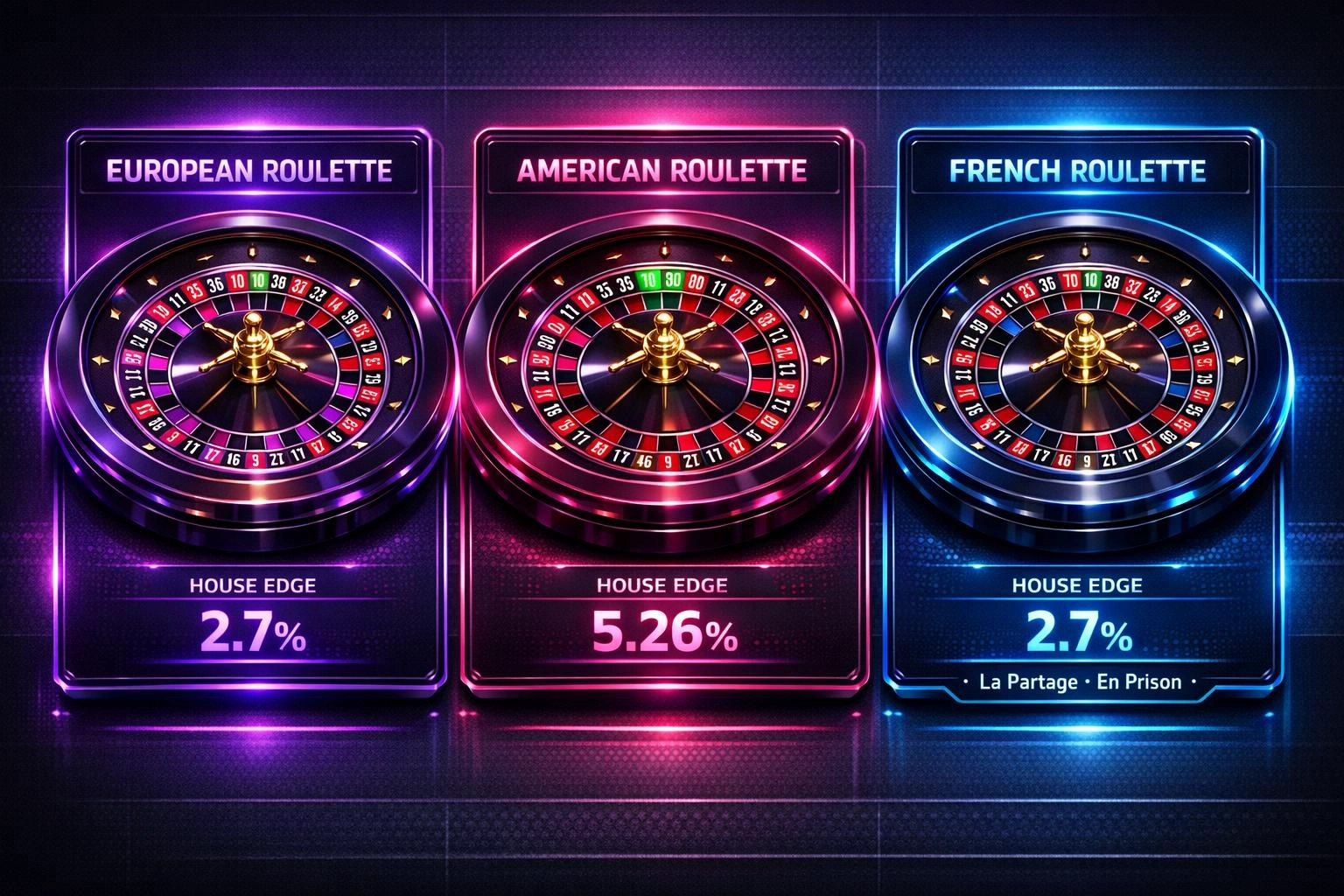
- European Roulette: Features a single zero, offering a house edge of 2.70%. A balanced choice with better odds than American roulette.
- American Roulette: Adds a double zero, raising the house edge to 5.26%. Avoid this version if you're aiming for better returns.
- French Roulette: Uses the same single-zero wheel as European but introduces La Partage and En Prison rules. These reduce the house edge on even-money bets to just 1.35%, making it the most favorable option.
Quick Tip: If you want the best odds, stick to French roulette, especially for even-money bets like red/black or odd/even. European roulette is a solid backup, but steer clear of American roulette unless no other options are available.
Quick Comparison
| Feature | American Roulette | European Roulette | French Roulette |
|---|---|---|---|
| Wheel Pockets | 38 (0, 00, 1–36) | 37 (0, 1–36) | 37 (0, 1–36) |
| House Edge (Standard) | 5.26% | 2.70% | 2.70% |
| House Edge (Even-Money) | 5.26% | 2.70% | 1.35% |
| Special Rules | None | None | La Partage, En Prison |
Your choice of roulette variant can make or break your strategy. French roulette offers the best odds, followed by European. American roulette, with its higher house edge, is the least player-friendly option.
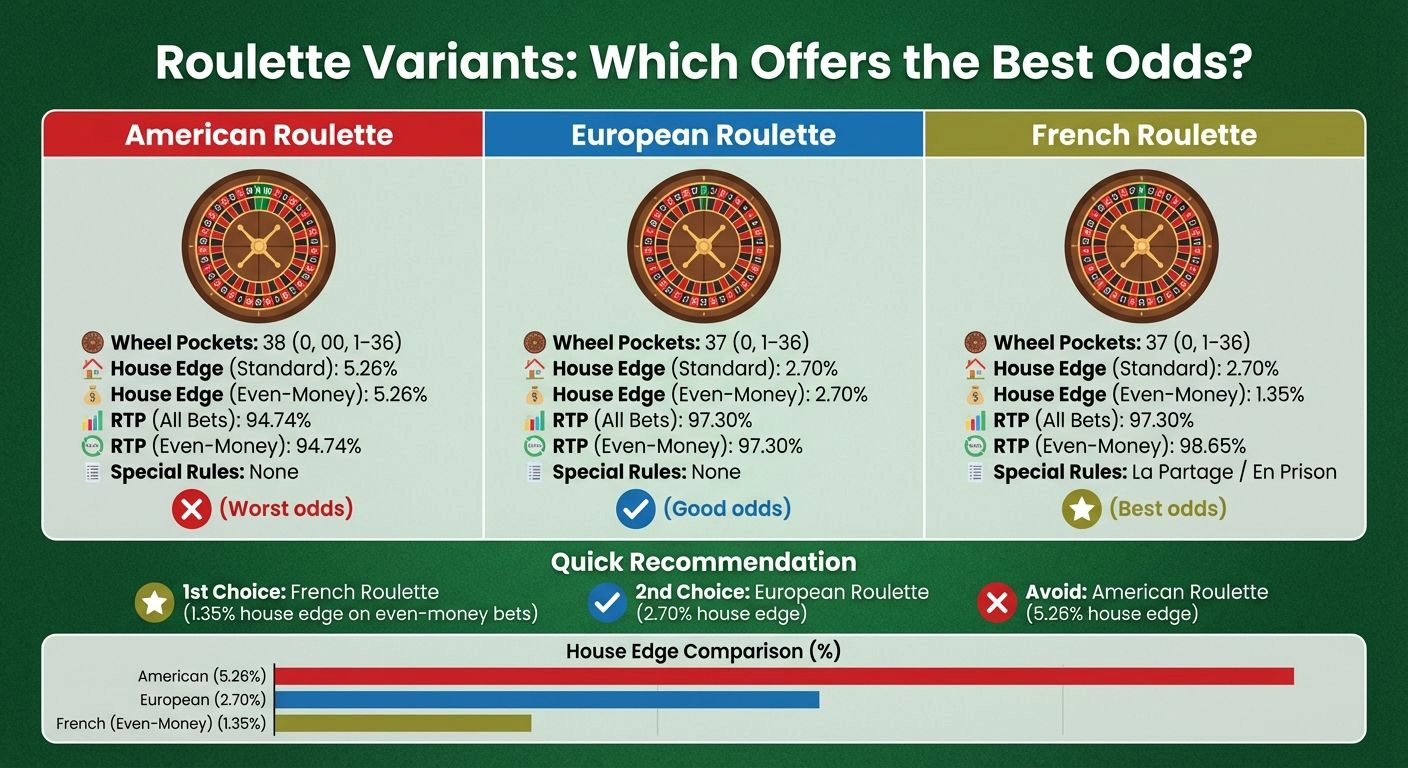
Roulette Variants Comparison: House Edge and Odds Across American, European, and French Roulette
European Roulette
Wheel Layout and Basic Rules
European roulette features a wheel with 37 pockets, numbered 0 through 36. What makes this version stand out is its single green zero pocket, which contributes to its lower house edge compared to the American version. For numbers 1–10 and 19–28, odd numbers are red, and even numbers are black. For numbers 11–18 and 29–36, the color pattern flips.
The game starts with players placing bets on where they think the ball will land. Once all bets are placed, the dealer spins the wheel and the ball in opposite directions. When the ball comes to rest in one of the pockets, the dealer places a marker, called a "dolly", on the winning number. Losing bets are cleared, and winning bets are paid out accordingly.
The wheel follows a fixed clockwise sequence: 0, 32, 15, 19, 4, 21, 2, 25, 17, 34, 6, 27, 13, 36, 11, 30, 8, 23, 10, 5, 24, 16, 33, 1, 20, 14, 31, 9, 22, 18, 29, 7, 28, 12, 35, 3, 26. This sequence ensures an even distribution of numbers and colors across the wheel, shaping the game’s dynamics and influencing its odds.
House Edge and Odds
Thanks to the single zero, European roulette has a house edge of 2.70%. This means that for every $100 wagered, the casino keeps about $2.70. The house edge exists because the payout odds are slightly less than the true odds. For example, while a straight-up bet has true odds of 36 to 1, it pays out at only 35 to 1.
The likelihood of winning depends on the type of bet. A straight-up bet on one number has a 2.70% chance (1 in 37) of winning and offers a 35:1 payout. On the other hand, even-money bets like red/black or odd/even have a winning probability of around 48.64% (18 out of 37) and pay 1:1.
"The European roulette game is generally considered to be better. It has half the house advantage, which means you can play longer and win more often" - Kevin Lentz, a land-based casino manager.
| Bet Type | Numbers Covered | Winning Probability | Payout |
|---|---|---|---|
| Straight-up (Single Number) | 1 | 2.70% | 35:1 |
| Split (Two Numbers) | 2 | 5.41% | 17:1 |
| Street (Three Numbers) | 3 | 8.11% | 11:1 |
| Corner (Four Numbers) | 4 | 10.81% | 8:1 |
| Six Line (Six Numbers) | 6 | 16.22% | 5:1 |
| Column / Dozen | 12 | 32.43% | 2:1 |
| Even-Money (Red/Black, etc.) | 18 | 48.64% | 1:1 |
American Roulette
Wheel Layout and Basic Rules
American roulette features a wheel with 38 pockets: numbers 1 through 36, a single zero (0), and a double zero (00). The inclusion of the double-zero pocket sets it apart from European roulette and has a noticeable effect on the odds.
The numbers on the wheel are arranged in this specific counterclockwise order:
0, 2, 14, 35, 23, 4, 16, 33, 21, 6, 18, 31, 19, 8, 12, 29, 25, 10, 27, 00, 1, 13, 36, 24, 3, 15, 34, 22, 5, 17, 32, 20, 7, 11, 30, 26, 9, 28.
The 0 and 00 pockets are located on opposite sides of the wheel, and adjacent numbers never share the same color.
A standout feature in American roulette is the "Top Line" bet (also known as the "First Five"). This wager covers the numbers 0, 00, 1, 2, and 3. While unique to this version of the game, it comes with a steep house edge of 7.89%, making it the least favorable option for players.
House Edge and Odds
The double zero increases the house edge in American roulette to 5.26%, nearly twice as high as in European roulette. Despite the payout for a straight-up bet remaining 35 to 1 in both versions, the likelihood of hitting a single number drops to 2.63% (1 in 38) compared to 2.70% (1 in 37) in European roulette.
For even-money bets, like red/black or odd/even, the chance of winning in American roulette is 47.37% (18 out of 38), slightly lower than the 48.64% offered in the European version. That additional pocket tilts the odds further in favor of the house.
| Bet Type | Numbers Covered | Winning Probability | Payout | House Edge |
|---|---|---|---|---|
| Straight-up (Single Number) | 1 | 2.63% | 35:1 | 5.26% |
| Split (Two Numbers) | 2 | 5.26% | 17:1 | 5.26% |
| Street (Three Numbers) | 3 | 7.89% | 11:1 | 5.26% |
| Corner (Four Numbers) | 4 | 10.53% | 8:1 | 5.26% |
| First Five (0, 00, 1, 2, 3) | 5 | 13.16% | 6:1 | 7.89% |
| Six Line (Six Numbers) | 6 | 15.79% | 5:1 | 5.26% |
| Even-Money (Red/Black, etc.) | 18 | 47.37% | 1:1 | 5.26% |
If you're playing in Atlantic City, there's a special rule for even-money bets: when the ball lands on 0 or 00, you only lose half your stake. This adjustment reduces the house edge on those bets to 2.63%, giving you slightly better odds in that setting.
Up next, we'll look at how French roulette introduces additional betting options and rules to further shape the game.
French Roulette
Wheel Layout and Basic Rules
French roulette uses a 37-pocket wheel, much like European roulette, but its layout and terminology set it apart. The betting grid features traditional French terms and has a unique design. Unlike European and American tables, where outside bets are grouped on one side, French tables place these betting boxes on both sides of the central grid. You'll see terms like Manque for Low (1–18), Passe for High (19–36), Impair for Odd, and Pair for Even.
Another notable feature is the "racetrack" layout (champ de courses), which allows for special call bets targeting specific sections of the wheel. These include:
- Voisins du Zéro: Covers 17 numbers around zero.
- Le Tiers du Cylindre: Covers 12 numbers opposite zero.
- Orphelins: Covers the remaining 8 numbers not included in the other two sections.
French roulette tables are typically larger, staffed by multiple dealers, and equipped with rakes for managing chips. This setup not only adds to the elegance of the game but also accommodates the specialized betting options that make French roulette stand out.
La Partage and En Prison Rules
French roulette introduces two rules that are exclusive to even-money bets like Red/Black, Odd/Even, and High/Low. These rules, La Partage and En Prison, are designed to improve your chances when placing these types of wagers.
- La Partage: If the ball lands on zero, you get half your stake back on even-money bets. For example, a $100 bet on red would return $50 if zero hits, instead of losing the entire amount.
- En Prison: In this case, your even-money bet is "locked" for the next spin if zero hits. If you win on the following spin, you recover your full stake. However, if you lose or zero comes up again, the bet is forfeited.
While the mechanics differ, both rules offer the same mathematical advantage, making even-money bets far more favorable to players.
House Edge and Odds
French roulette is known for having the lowest house edge among roulette variations. When La Partage or En Prison rules apply, the house edge on even-money bets drops to just 1.35%, significantly better than the 2.70% edge in European roulette and far superior to the 5.26% edge in American roulette. This translates to a Return to Player (RTP) of 98.65% for even-money bets.
"French Roulette is often considered the 'pro's choice.' While it uses the same single-zero wheel as European Roulette, unique rules like La Partage and En Prison make it the most mathematically favorable version of the game for the player." – Roulette.Casino
For all other bets, such as straight-ups, splits, and corners, the house edge remains at the standard 2.70%, matching European roulette. The real edge of French roulette lies in sticking to even-money bets and leveraging these player-friendly rules to maximize your odds.
French Roulette vs European Roulette vs American Roulette: Which to Play?
Comparing the 3 Variants
When it comes to roulette, the differences between the three main variants - American, European, and French - are more than just cosmetic. The biggest distinction lies in the wheel design, specifically the number of zero pockets. American roulette includes both a single zero (0) and a double zero (00), giving it 38 pockets in total. Meanwhile, European and French roulette use a single-zero wheel with 37 pockets. This extra pocket in American roulette significantly boosts the house edge, making it less favorable for players.
The house edge in American roulette is higher due to the additional zero. In contrast, while European and French roulette share the same wheel design, French roulette introduces two unique rules - La Partage and En Prison - which reduce the house edge on even-money bets by half.
Table layouts also vary, impacting the game's pace and atmosphere. American roulette tables place all outside bets on one side of the layout, creating a faster game typically managed by a single dealer. On the other hand, French roulette tables divide outside bets across both sides of the betting grid, fostering a more formal environment often requiring multiple croupiers.
"The American wheel has a 5.3% house advantage while the European wheel is better for the player, with a reduced house advantage of only 2.7%." – Ioannis Kavouras, Professional Roulette Player
Below is a table summarizing the key differences between these variants:
Comparison Table
| Feature | American Roulette | European Roulette | French Roulette |
|---|---|---|---|
| Wheel Pockets | 38 (0, 00, 1–36) | 37 (0, 1–36) | 37 (0, 1–36) |
| Standard House Edge | 5.26% | 2.70% | 2.70% |
| Even-Money House Edge | 5.26% | 2.70% | 1.35% |
| RTP (All Bets) | 94.74% | 97.30% | 97.30% |
| RTP (Even-Money Bets) | 94.74% | 97.30% | 98.65% |
| Special Rules | None | None | La Partage / En Prison |
The table highlights a clear takeaway: French roulette provides the most favorable odds for players, especially on even-money bets, thanks to its special rules. European roulette follows, while American roulette lags behind due to its higher house edge. Understanding these differences can help you pick the version that aligns with your strategy and comfort with risk.
Which Variant Offers the Best Odds at Windice

When it comes to increasing your chances of winning at Windice, understanding the house edge is key. For roulette enthusiasts, French roulette stands out as the best choice for even-money bets like Red/Black, Odd/Even, or High/Low. Thanks to the La Partage and En Prison rules, the house edge on these wagers is reduced to just 1.35% - a significant improvement over other roulette variants like European and American wheels. As iGaming analyst Caesar Fikson explains:
"If you understand how the pockets, payouts, and special rules interact, you stop donating edge by accident and start buying the best version of the same game."
This makes French roulette the go-to option for players looking to minimize the house advantage.
If French roulette isn’t available, European roulette is a solid alternative. Its single-zero wheel results in a 2.70% house edge across all bets - still much better than the 5.26% house edge found in American roulette. To put it into perspective, a $100 wager over 100 spins would lose around $270 in European roulette compared to $526 in American roulette.
On the flip side, American roulette should be avoided. The additional double-zero pocket increases the house edge, and the notorious "basket" bet (covering 0, 00, 1, 2, and 3) comes with an even steeper 7.89% house edge.
Windice doesn’t just offer favorable odds; it enhances your gaming experience in other ways too. The platform supports multiple cryptocurrencies, ensuring fast and secure transactions with instant payouts. Plus, every spin is backed by provably fair technology, so you can verify the randomness of each result. This transparency builds trust while also providing better mathematical returns.
To top it off, Windice fosters a vibrant community through an active on-site chat and dedicated forum. Here, players can share strategies, exchange tips, and connect with others. Whether you’re spinning the European roulette wheel powered by Evolution Gaming or enjoying live dealer games from Pragmatic Play, Windice combines competitive house edges with engaging social features and secure, transparent operations.
Conclusion
Selecting the right roulette variant can make a big difference in your long-term gaming outcomes. For example, American roulette, with its 38 pockets (including 0 and 00), has a house edge of 5.26%, nearly double the 2.70% found in European roulette. French roulette goes even further, lowering the house edge on even-money bets to just 1.35% thanks to the La Partage and En Prison rules.
As roulette expert Ioannis Kavouras explains:
"Overall, the best conditions a roulette player can find in a casino are: a French roulette rules on a European wheel."
To put this into perspective, if you're betting $100 over 100 spins, the expected cost would be $526 on an American wheel versus $270 on a European one. These differences in odds can heavily influence your strategy and overall success at Windice.
Whether you're enjoying European roulette powered by Evolution Gaming or trying live dealer games from Pragmatic Play, understanding the odds of each variant helps you make smarter choices and stretch your bankroll further. Paired with Windice's provably fair technology, instant cryptocurrency payouts, and interactive community features, you're set for a gaming experience that’s both fair and engaging.
FAQs
How do I know if a table is European, American, or French?
You can tell the type of roulette by looking at the wheel layout and understanding the rules. European roulette features numbers 1 through 36 and a single zero (0), giving it a house edge of about 2.7%. American roulette, on the other hand, includes an extra double zero (00), which increases the house edge to roughly 5.26%. French roulette is similar to European roulette but often incorporates rules like La Partage, which can reduce the house edge even more.
Do La Partage and En Prison apply to all bets or only even-money bets?
The La Partage and En Prison rules are specific to even-money bets in roulette - these include red/black, odd/even, and high/low wagers.
With La Partage, if the ball lands on zero, you lose only half of your bet, while the other half is returned to you. On the other hand, En Prison gives your bet another chance: it’s locked in for the next spin. If that spin wins, you get your bet back. If it loses, the entire bet is forfeited.
Which roulette bets offer the best odds for beginners?
For beginners, the safest bets in roulette are outside bets like red/black, odd/even, or high/low numbers. These options are straightforward and offer nearly a 50% chance of winning, with payouts at 1:1. On the other hand, inside bets, such as betting on a single number, come with much lower odds - around 2.7% in European roulette - but offer significantly higher payouts. While tempting, these riskier bets might not be ideal for those just starting out and looking for steadier results.



 8001
8001